Unintended Policy Effects
Rethinking Policy Analysis and Evaluation through Aviation
This book empirically examines the unintended effects of aviation policies. It focuses on airport slot systems, policy measures affecting fuel use and emissions, and tarmac delay rules, and analyzes their effects on competition, airfares, fuel consumption, and flight cancellations. The book also examines the limitations of methods to estimate policy effects. It highlights the “problem-articulation function” of academic research: identifying overlooked problems and unintended consequences arising from policies and the methods used to evaluate them.
This book empirically examines the unintended consequences of public policy, using aviation policy as its main focus. Except for the introduction and conclusion, each chapter is based on the author’s research published in international peer-reviewed journals. The book aims to combine academic rigor with a practical understanding of how policies work in the real world.
Specifically, it examines airport slot trading in the United States and the United Kingdom and finds that market mechanisms do not always promote competition. Airlines’ strategic use of slot systems may instead allow them to avoid competition, effectively limit airport capacity, and increase airfares. The book also evaluates policy measures that affect fuel use and emissions, including aviation fuel taxes and airport surface metering. It finds that these measures can reduce fuel consumption and CO2 emissions, although the effects may not last over time.
The book also analyzes the U.S. tarmac delay rule and highlights an important policy trade-off. Although the rule reduces prolonged onboard delays on the ground, it may also increase flight cancellations. In addition, the book examines matching and weighting methods for estimating policy effects. Simulation results show that, under certain conditions, these methods may increase rather than reduce estimation bias.
The book’s central message is that policy analysis and evaluation should consider not only intended effects but also overlooked side effects and unintended consequences. The author argues that academic research has a “problem-articulation function” in addition to its role in estimating policy effects. This means identifying problems that have received insufficient attention, explaining them clearly, and bringing them into broader public and policy discussions.
The analytical framework developed in this book can be applied not only to aviation policy but also to a wide range of policy areas. It examines how institutional design interacts with firms’ strategic behavior and how the choice of analytical methods can affect research findings. The book’s main objective is to provide a fuller understanding of policy consequences, including side effects, and to identify ways to improve policymaking. Data and Stata code used in the book are available on the companion website.
The book received the 2026 Book Award from the Public Policy Studies Association, Japan.
Reference URL: https://doi.org/10.1007/978-981-96-7303-2
Bibliographic Information
Title:Aviation Policies: Studies of Unintended Effects and Consequences
Authors:Fukui, H. (2025).
Publisher:Springer.
DOI: 10.1007/978-981-96-7303-2
xii + 516 pages; 176 illustrations, including 1 in color
Companion website: https://sites.google.com/view/aviation-policies/
Fundings
- Japan Society for the Promotion of Science (JSPS) KAKENHI Grant Number 24K04719, 21KK0028
Media
-
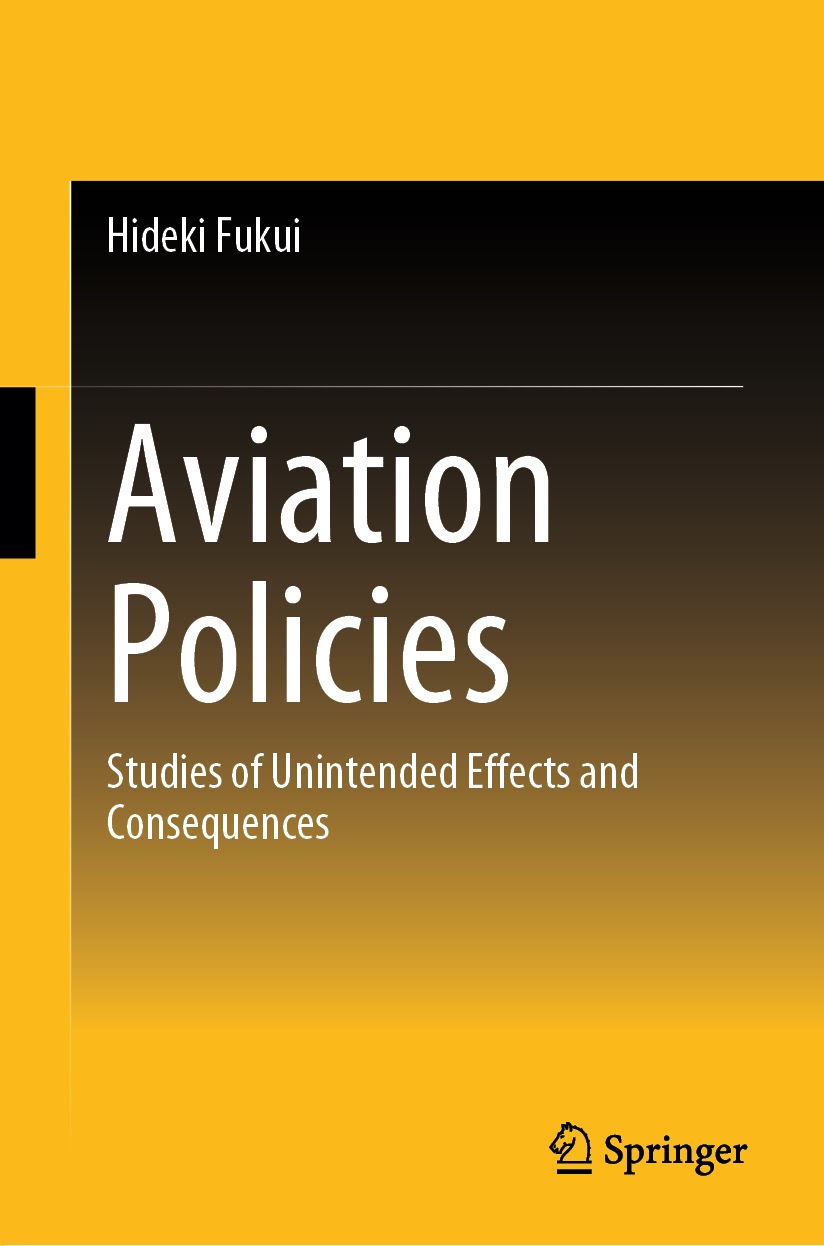
Fig. 1
Book Cover
credit : Springer Nature
Usage Restriction : Unauthorized reproduction or redistribution is prohibited
Contact Person
Name : Hideki Fukui
Phone : +81-89-927-8208
E-mail : fukui.hideki.hz@ehime-u.ac.jp
Affiliation : Faculty of Law and Letters