
Ion Channels Inside Cells Were Manipulating the Cytoskeleton
Novel Function of Proton Channels in Intracellular Membranes
We revealed that the proton channel Hv1/VSOP, previously thought to function at the cell surface in microglia (brain immune cells), also functions on endosomes inside cells and precisely controls the actin cytoskeleton. Using advanced microscopy and electrophysiology (endosome patch-clamp), we found Hv1 acts as a brake on actin elongation. This discovery presents a novel cellular control mechanism where endosomal ion channels manipulate the cell skeleton itself, with implications for understanding neurodegenerative diseases.
Microglia, the immune cells that protect our brain, are thought to maintain a healthy brain environment by removing unwanted substances through dynamic remodeling of the actin cytoskeleton, the cell’s internal framework. It has been known that microglia express Hv1/VSOP, a channel protein that transports protons, but it was believed to function at the cell membrane surface, regulating pH in its vicinity.
Our research group has now revealed that Hv1 functions not only at the cell surface but also on endosomes, transport vesicles known to carry substances inside cells. First, by combining advanced microscopy with endosome patch-clamp techniques—a highly sensitive method capable of directly measuring ion flow from microscopic membrane structures inside cells—we demonstrated that Hv1 actually functions as a proton channel on endosomes.
Furthermore, analysis of microglia lacking Hv1 showed that the actin cytoskeleton elongated excessively, disrupting cell shape and internal structure. This suggested that Hv1 functions as a brake that suppresses actin elongation. Detailed biochemical analysis revealed that Hv1 interacts with CAPZ, a protein that binds to actin filament ends, appropriately suppressing actin cytoskeleton growth. Additionally, real-time observation of living cells successfully captured endosomes carrying Hv1 binding to the tips of actin filaments. These results demonstrate a new cellular control mechanism in which ion channels on endosomes are physically involved in the formation and arrangement of the cell skeleton.
Reference URL: https://www.pnas.org/doi/10.1073/pnas.2521977123
Bibliographic Information
Title: Voltage-gated proton channel Hv1/VSOP regulates reciprocal interactions between F-actin and endosomes in microglia
Authors: Takafumi Kawai, Daisuke Yoshioka, Pattama Wiriyasermkul, Risa Mori-Kreiner, Rizki Tsari Andriani, Megumi Kobayashi, Manabu Abe, Kenji Sakimura, Kazuki Nagayasu, Shushi Nagamori, Yasushi Okamura,
Journal: Proc Natl Acad Sci U S A. 2026 Apr 21;123(16):e2521977123
DOI: 10.1073/pnas.2521977123
Fundings
- JSPS KAKENHI: 15K18575, 23K06334, 25K02442, 23K24066, 19H03401, 20H05791, 25H01334
- JST FOREST: JPMJFR225Z
Media
-
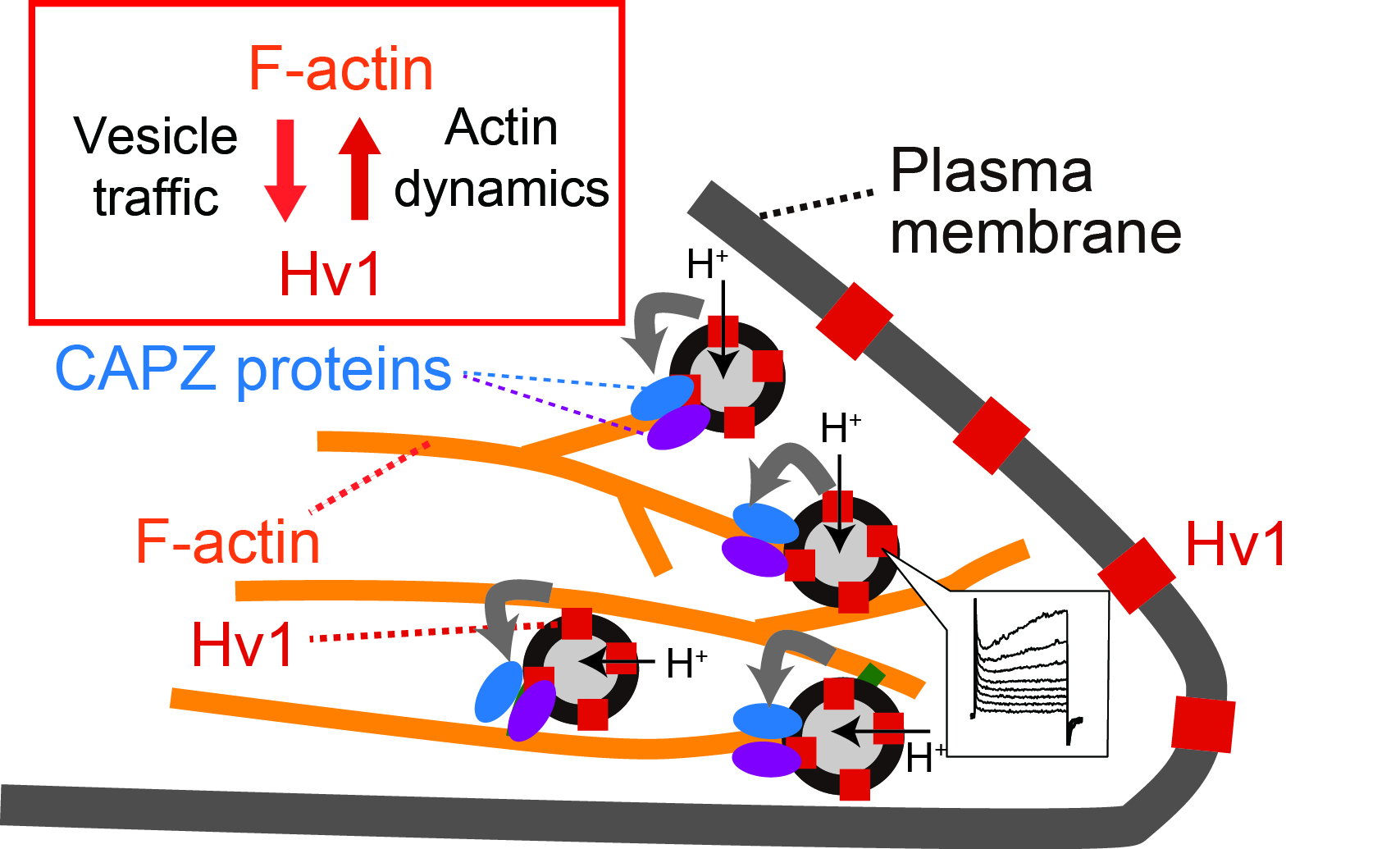
Hv1 on Endosomes Regulates Actin Cytoskeleton
We demonstrated for the first time that Hv1 is present and functional on endosomes. Additionally, Hv1 controlled actin cytoskeleton function via a protein called CapZ. The actin cytoskeleton was also involved in the transport of Hv1 itself.
credit : Takafumi Kawai
Usage Restriction : Permission required for use
Contact Person
Name : Takafumi Kawai
Phone : +81-89-960-5241
E-mail : kawai.takafumi.ra@ehime-u.ac.jp
Affiliation : Faculty of Medicine, Department of Molecular and Cellular Physiology