
Developing a New Predictive Model to Assess Chemical Risks in Cetaceans

Assessing the Impact of Chemical Contaminants on Finless Porpoises Using In Vitro Data and Mass Distribution Modeling
Assessing the health impacts of persistent organic pollutants (POPs) in cetaceans is challenging due to ethical constraints on live animal testing. This study developed a predictive "QIVIVE" model for finless porpoises. By calculating the "freely dissolved concentration" of POPs using a mass distribution model, we discovered that current environmental exposure levels pose a low risk to cell viability. This novel framework enables precise, ethical chemical risk assessments for marine mammals.
[Background]
Cetaceans, as apex predators in the marine ecosystem, accumulate persistent organic pollutants (POPs) at high concentrations. However, due to ethical constraints, toxicity testing using live animals is impossible, leaving a long-standing challenge of how to link the results of in vitro experiments (using cultured cells) to actual “in vivo risk assessments.” Conventionally, the “nominal concentrations” in cell experiments were directly compared with the “measured total concentrations” in actual organisms. However, this method carries high uncertainty because it does not account for the binding of chemicals to proteins and lipids within the body.
[Methodology]
Using the finless porpoise as a model species, this study introduced a quantitative approach to predict actual in vivo effects from cell experiment results by using the “freely dissolved concentration” (the concentration of free chemicals not bound to proteins or lipids), which is directly responsible for triggering toxicity, as a common metric. We measured the protein and lipid contents of finless porpoise blood and blubber, as well as the culture media used in the cell experiments, and constructed a mass distribution model for 15 types of POPs.
[Results]
The mass distribution modeling revealed that the freely dissolved concentrations of POPs in the bioassay media, blood, and blubber were 2-3, 4-6, and 6-8 orders of magnitude lower than their nominal and measured total concentrations, respectively. Using this freely dissolved concentration as a baseline, we calculated the “QIVIVE ratio” (risk prediction ratio) to compare actual exposure concentrations in vivo with the effect concentrations in cell experiments. The results indicated that mixed exposure to POPs at current environmental levels poses a low risk of reducing cell viability or inducing apoptosis (cell death).
[Future Outlook]
This predictive approach, based on mass distribution modeling and freely dissolved concentrations, enables a realistic and mechanistically grounded risk assessment of chemicals in cetaceans. In the future, by incorporating chronic endpoints such as endocrine disruption and immunotoxicity into this framework, it is expected to be applied to more comprehensive health risk assessments for marine mammals.
Reference URL: https://doi.org/10.1021/acs.est.5c13935
Bibliographic Information
Quantitative in Vitro to in Vivo Extrapolation (QIVIVE) for Risk Assessment of Persistent Organic Pollutant Mixtures in Cetaceans,
Islem Boukara, Satoshi Endo, Mari Ochiai, Luise Henneberger, Beate I. Escher, and Hisato Iwata,
Environmental Science & Technology,
doi:10.1021/acs.est.5c13935, 2026 (March 9).
Fundings
- MEXT LaMer project
- JSPS KAKENHI 19H01150, 24H00753, 25K03273
Media
-
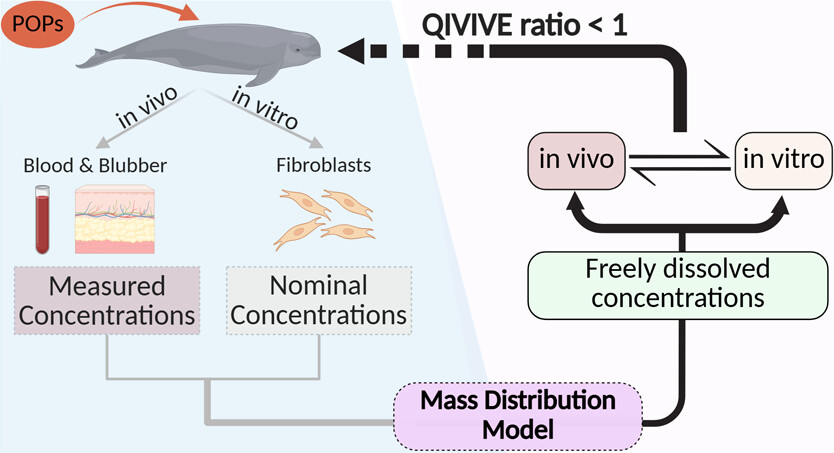
Conceptual Diagram of QIVIVE Risk Assessment for POPs in Cetaceans
A conceptual diagram of the risk assessment framework evaluating the health risks of harmful chemicals (POPs) by comparing data from finless porpoise biological samples (blood and blubber) with cultured cell data.
credit : Environ. Sci. Technol. 2026, 60, 11, 8353-8362
Usage Restriction : Please get copyright permission
Contact Person
Name : Hisato Iwata
Phone : 089-927-8172
E-mail : iwata.hisato.mz@ehime-u.ac.jp
Affiliation : Center for Marine Environmental Studies (CMES), Premier Institute for Advanced Studies (PIAS), Ehime University