
Successful High-Purity Synthesis of the Challenging-to-Produce Cerium Orthoferrite!
Achieving 99 mol% Phase Purity of Cerium Orthoferrite (CeFeO3) by Controlling Hydrogen Concentration and Gas Flow Rate, and Elucidating Its Formation Mechanism
A research team including Ehime University successfully synthesized high-purity CeFeO3, a difficult-to-produce cerium–iron mixed oxide, using hydrogen reduction. By optimizing hydrogen concentration and gas flow rate, they achieved a phase purity of up to 99 mol%. The team also clarified the formation mechanism and identified factors that hinder synthesis. This method provides a foundation for future research into applications in magnetic materials and catalysis.
【Research Background】
Cerium orthoferrite (CeFeO3) is an oxide with a crystal structure known as the “perovskite structure.” Potential applications of CeFeO3 have been reported in areas such as methane reforming and photocatalytic reactions. However, under conventional synthesis conditions, cerium tends to form the stable oxide cerium dioxide (CeO2), making it difficult to synthesize CeFeO3 with high phase purity. Conventional synthesis methods also have several limitations, including the need for long processing times or specialized equipment.
【Research Methods】
The research team investigated a synthesis method in which mixed oxides of cerium dioxide (CeO2) and iron(III) oxide (Fe2O3) were heated under a mixed hydrogen and nitrogen gas atmosphere. After comparing different methods for preparing the starting materials, the team varied the hydrogen concentration and gas flow rate and conducted reduction treatments at 800 °C (1073 K) for two hours.
The crystalline phases of the resulting products were characterized using powder X-ray diffraction (XRD) and Rietveld refinement. Changes occurring during the reaction were monitored by measuring hydrogen consumption and performing XRD and X-ray absorption near-edge structure (XANES) analyses.
【Key Findings】
Under a hydrogen concentration of 1.25% and a gas flow rate of 50.0 cm3/min, the phase purity of CeFeO3 reached 99 mol%, as determined by Rietveld refinement. The researchers found that excessively high hydrogen concentrations or gas flow rates promoted the reduction of iron in the starting materials to metallic iron, thereby suppressing the formation of the desired CeFeO3 phase.
Analysis of samples collected at different stages of the reaction revealed that iron(III) oxide (Fe2O3) was reduced stepwise to iron(II) oxide (FeO), which subsequently reacted with cerium dioxide (CeO2) to form CeFeO3. Under excessively strong reducing conditions, FeO was further reduced to metallic iron. These findings demonstrate the importance of maintaining appropriately controlled reducing conditions.
【Significance and Future Perspectives】
This study identified the conditions required to synthesize CeFeO3 with high phase purity through a relatively simple hydrogen reduction process and clarified the underlying formation mechanism.
Although CeFeO3 has attracted interest for potential applications in catalysis and related fields, this study did not demonstrate its catalytic performance or the productivity of the synthesis process under practical industrial conditions.
The insights into CeFeO3 synthesis obtained from this research provide a foundation for future investigations of its properties and potential applications.
Reference URL: https://doi.org/10.1021/acs.inorgchem.6c03361
Bibliographic Information
Title:Conditions and Mechanism for the Formation of CeFeO3 via Hydrogen Reduction of CeO2−Fe2O3 Mixed Oxides
Authors:Masahiro Fujisaki, Sota Fukudome, Yo Hoshimori, Hiroyuki Yamaura, Syuhei Yamaguchi, Hiroyuki Setoyama, Rie Suizu, and Hidenori Yahiro
Journal:Inorganic Chemistry, 2026, 65, 23644–23653
Published: October 1, 2026
DOI: 10.1021/acs.inorgchem.6c03361
Fundings
- Japan Society for the Promotion of Science(JSPS) KAKENHI Grant Number JP26K08119
- Use of Related Facilities: SAGA-LS BL11 (Project No.179-2515180G)
Media
-
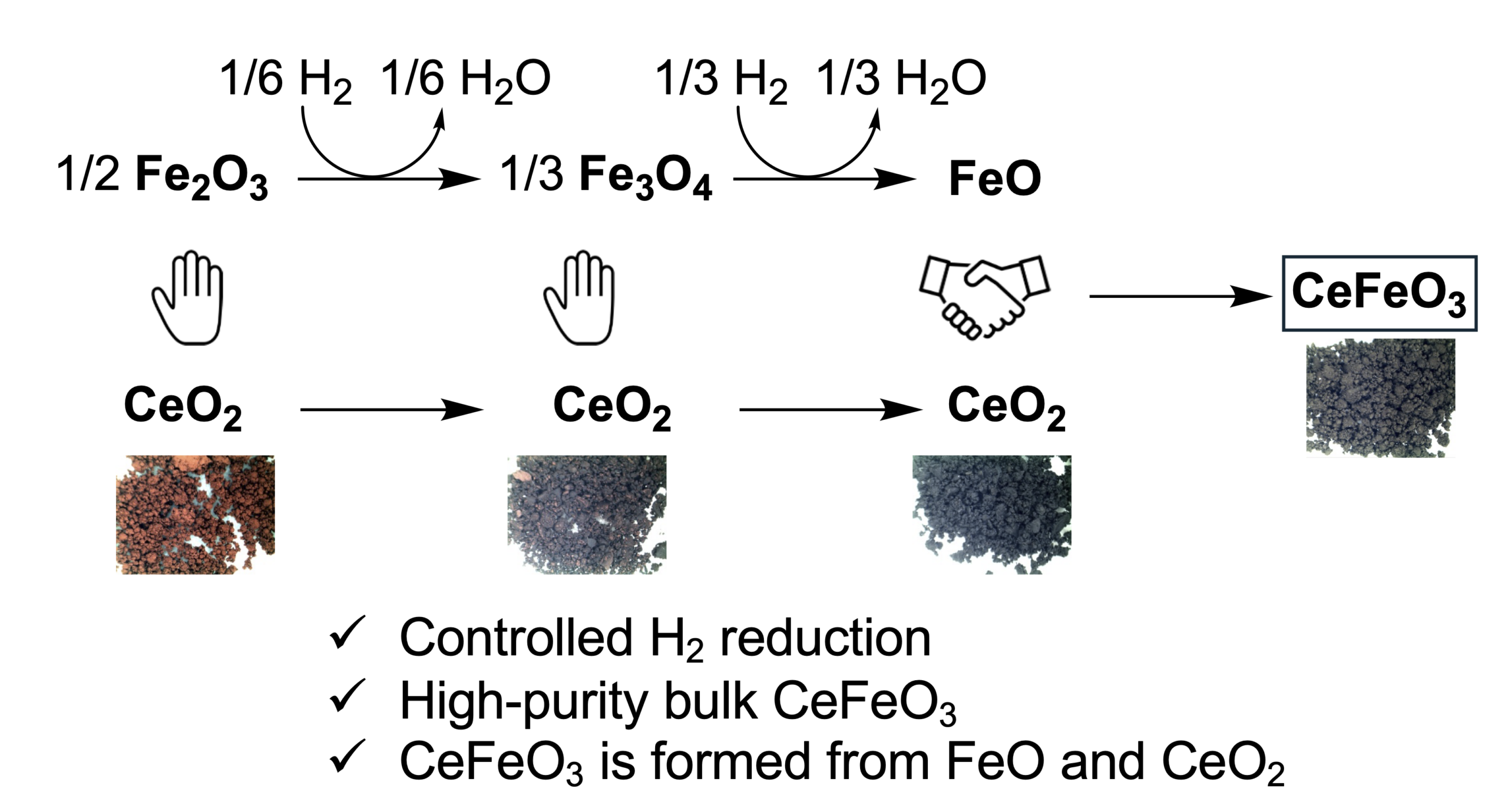
Mechanism of CeFeO3 Formation
The process by which CeFeO3 is formed through the stepwise reduction of Fe2O3 with hydrogen, followed by a reaction between FeO and CeO2. (Reproduced from M. Fujisaki et al., Inorg. Chem., 2026, DOI: 10.1021/acs.inorgchem.6c03361. Copyright © 2025 American Chemical Society)
credit : M. Fujisaki, S. Fukudome, Y. Hoshimori, H. Yamaura, S. Yamaguchi, H. Setoyama, R. Suizu, H. Yahiro
Usage Restriction : Reproduction or redistribution without permission is prohibited.
Contact Person
Name : Masahiro Fujisaki
Phone : +81-89-927-9946
E-mail : fujisaki.masahiro.gw@ehime-u.ac.jp
Affiliation : Graduate School of Science and Engineering