
Tiny molecular changes, big microparticle deformation
Hierarchical propagation of molecular photoisomerization into particle-scale deformation
Tomomichi Itoh and his colleagues at Ehime University have shown how tiny light-induced molecular shape changes can be amplified into visible deformation of polymer microparticles. The team developed light-responsive particles containing azobenzene molecules and revealed how structural changes triggered by light spread through the material, ultimately deforming particles several to tens of micrometers in size. These findings provide new insights for designing light-driven microscale materials and devices.
Materials that change their shape upon exposure to light are attracting growing interest in applications such as soft robotics, microscale actuators, and smart materials. However, the connection between molecular-level structural changes and larger-scale deformation remains incompletely understood.
Tomomichi Itoh and his colleagues at Ehime University demonstrated that tiny light-induced structural changes within a polymer can be amplified into visible deformation of polymer microparticles. Their study revealed a hierarchical process that links molecular-scale events to shape changes in particles of several to tens of micrometers in size.
This research focused on azobenzene, a well-known light-responsive molecule that reversibly changes its shape under ultraviolet and visible light. Because of this unique property, azobenzene has been widely used in materials designed to respond to light.
Although azobenzene-driven deformation has been extensively studied in films and bulk materials, the processes occurring inside microscopic particles are not well understood. In particular, the structural pathway connecting molecular photoisomerization to particle-scale deformation remains unclear.
To investigate this, the researchers designed a polymer in which azobenzene units were incorporated directly into the main chain of the polymer. Using this material, they prepared polymer microparticles with diameters ranging from several micrometers to tens of micrometers.
Detailed analyses showed that light first changed the structure of the azobenzene units, followed by changes in the polymer chains and internal structure of the microparticles. These changes propagated through multiple structural levels and ultimately resulted in particle deformation.
This study established the following hierarchical pathway:
Azobenzene photoisomerization
↓
Polymer-chain rearrangement
↓
Reorganization of internal particle structure
↓
Microparticle deformation
The findings show how a molecular event can be translated into the deformation of an entire microparticle through a sequence of interconnected structural changes. This work provides a new design strategy for light-responsive microparticles, which may contribute to the development of light-driven micromachines, functional microparticles, and other advanced photoresponsive materials.
Reference URL: https://doi.org/10.1021/acs.macromol.6c02195
Bibliographic Information
Title:Coupled Photoisomerization, Chain Reorientation, and Shape Deformation in Main-Chain Azobenzene Polymer Particles Prepared by Heterogeneous Radical-Mediated Thiol–Ene Polyaddition
Title:Tomomichi Itoh*, Shoma Yamamoto, Yuito Takechi, Yuki Itoh, Hiroaki Shimomoto, and Eiji Ihara
Journal:Macromolecules, 2026, 59 (19), 10687–10699
DOI: 10.1021/acs.macromol.6c02195
Fundings
- Japan Society for the Promotion of Science (JSPS) KAKENHI Grant Number JP24K08543
Media
-
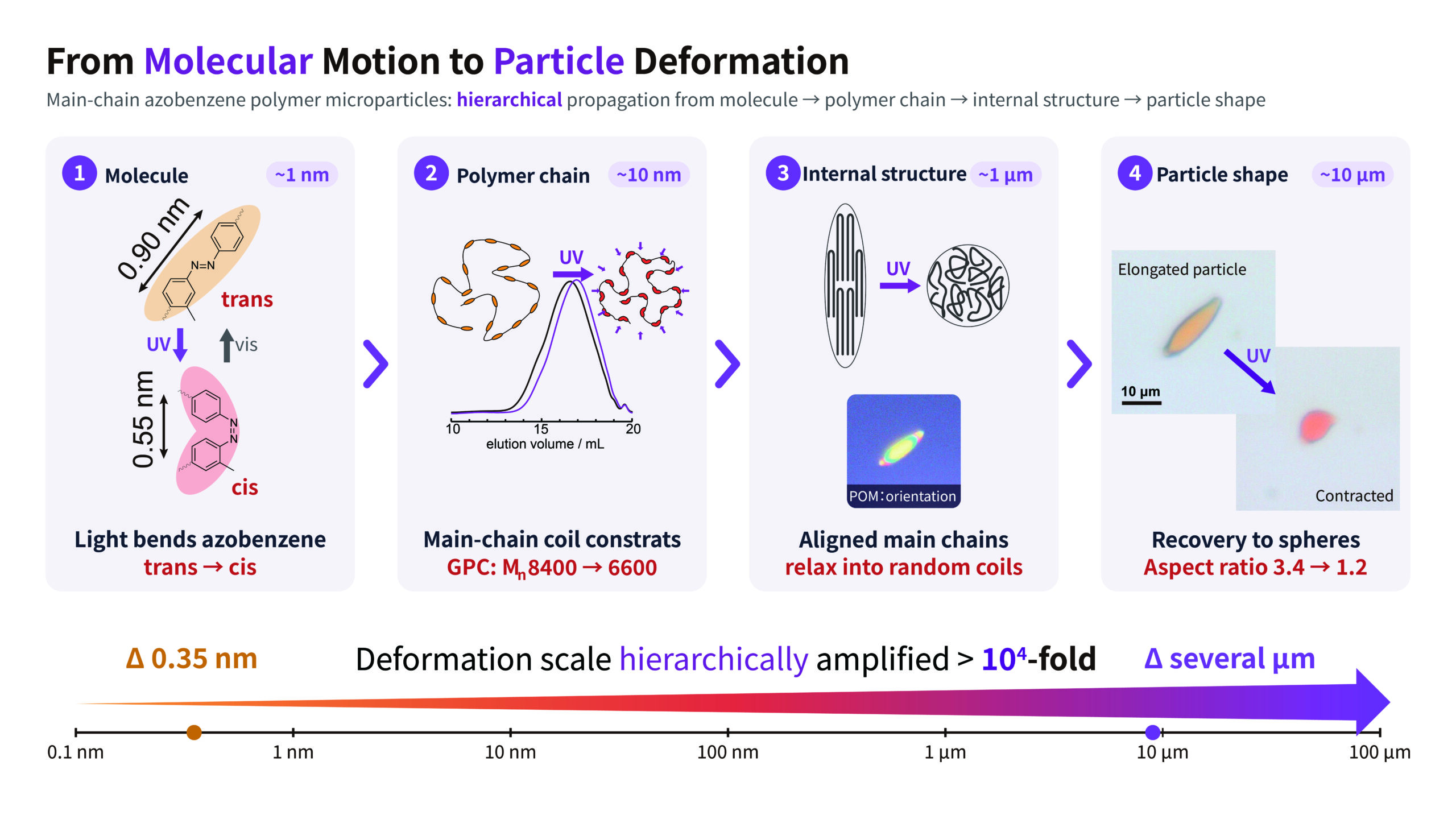
Dynamic Hierarchical Structural Changes in Main-Chain Azobenzene Polymer Microparticles
Light alters the structure of each azobenzene unit from the trans- to the cis-form. Because the azobenzene units are directly incorporated into the polymer backbone, this molecular-scale photoisomerization changes the polymer-chain conformation and the internal orientational structure of the microparticles. This hierarchical response is ultimately expressed as the deformation of polymer microparticles with diameters ranging from several to tens of micrometers. The micrographs show a deformed microparticle before and after ultraviolet-light irradiation.
credit : Tomomichi Itoh, Shoma Yamamoto, Yuito Takechi, Yuki Itoh, Hiroaki Shimomoto, and Eiji Ihara
Usage Restriction : Reproduction or redistribution without permission is prohibited
Contact Person
Name : Tomomichi Itoh
Phone : +81-89-927-8522
E-mail : itoh@ehime-u.ac.jp
Affiliation : Graduate School of Science and Engineering, Ehime University