
Nontrivial three-sublattice magnetization in the easy-axis spin-1/2 XXZ antiferromagnet on the triangular lattice
Ground-State Magnetism Revealed by Spiral-Boundary DMRG
We study the ground state of the spin-1/2 XXZ antiferromagnet on the triangular lattice in the easy-axis regime using density-matrix renormalization group with spiral boundary conditions. The ordered state remains a nontrivial three-sublattice Y-like structure over a wide anisotropy range. Extrapolation shows incomplete sublattice polarization even in the Ising limit. Energy comparisons demonstrate that the Y state is favored over the up-down-down state, stabilized by quantum fluctuations from the degenerate Ising manifold.
We investigate the ground-state magnetic structure of the spin-1/2 XXZ antiferromagnet on the triangular lattice in the easy-axis regime using the density-matrix renormalization group. By applying spiral boundary conditions, we exactly map finite L×L clusters onto one-dimensional chains while avoiding the spatial anisotropy inherent in cylindrical geometries. From symmetry-broken local magnetization profiles, we extract the three-sublattice moments and track their evolution with anisotropy. At the isotropic point, we obtain a positive sublattice moment of 0.217(3), consistent with previous numerical estimates. In the easy-axis regime (Δ=Jz/J⊥>1), the ordered moments remain close to a Y-like zero-magnetization three-sublattice state, whose z-component pattern is of the form (2m,−m,−m), over a broad range of Δ. Extrapolation in 1/Δ shows that the positive sublattice moment stays well below the classical saturation value 1/2, approaching 0.419(7) as Δ→∞, while the magnitude of the negative sublattice moment approaches 0.209(4). We further compare the energies of the Y state and the up-down-down state and find that the Y state is favored at zero field. Independent thermodynamic-limit energy calculations, performed without assuming any particular ordered pattern, yield an energy consistent with the Y-state solution. These results show that the easy-axis ground state does not simply cross over to a trivially saturated collinear Ising state, but instead remains a nontrivial three-sublattice ordered state selected from the macroscopically degenerate Ising manifold by quantum fluctuations.
Reference URL: https://doi.org/10.1103/lx93-brc2
Bibliographic Information
Title:“Nontrivial three-sublattice magnetization in the easy-axis spin-12 XXZ antiferromagnet on the triangular lattice”
Authors:Masahiro Kadosawa, Masaaki Nakamura, Yukinori Ohta, and Satoshi Nishimoto
Journal:Physical Review B 113, 224442 (2026)
DOI:https://doi.org/10.1103/lx93-brc2
Fundings
- Japan Society for the Promotion of Science (JSPS) KAKENHI Grant Number JP20H01849, No. JP20K03769, and JP21J20604
- SFB 1143 Project No. A05 (Project-id 247310070) of the Deutsche Forschungsgemeinschaft
Media
-
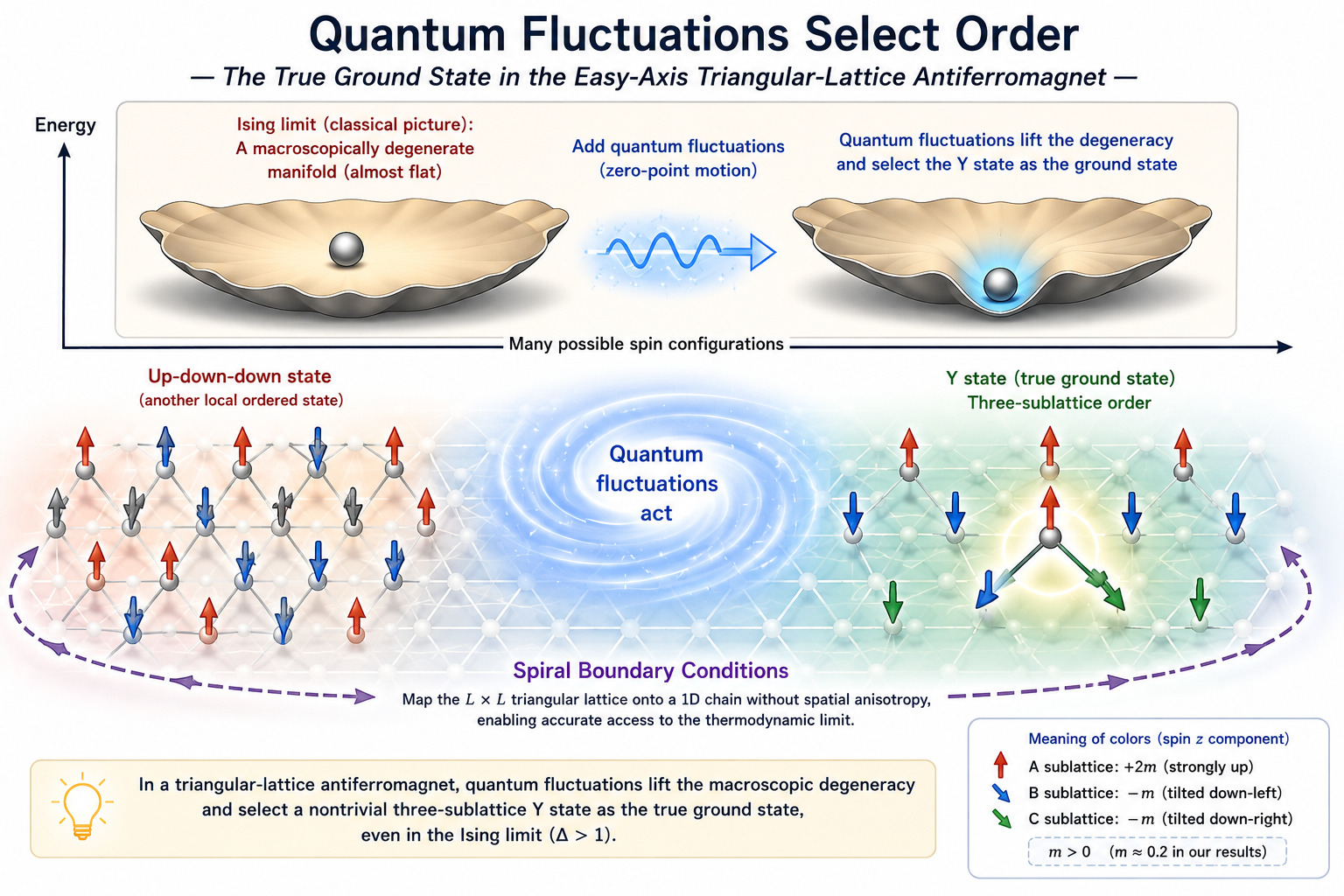
Quantum Fluctuations Select Order
Schematic illustration of how quantum fluctuations select magnetic order. On a triangular lattice, competing interactions between spins lead to many states with nearly the same energy, making it difficult for the system to select a unique state. Quantum fluctuations break this delicate balance and select a particular ordered state. Our study shows that quantum effects persist even in the strongly anisotropic limit, stabilizing a characteristic three-sublattice Y state.
credit : Masaaki Nakamura
Usage Restriction : Please get copyright permission -
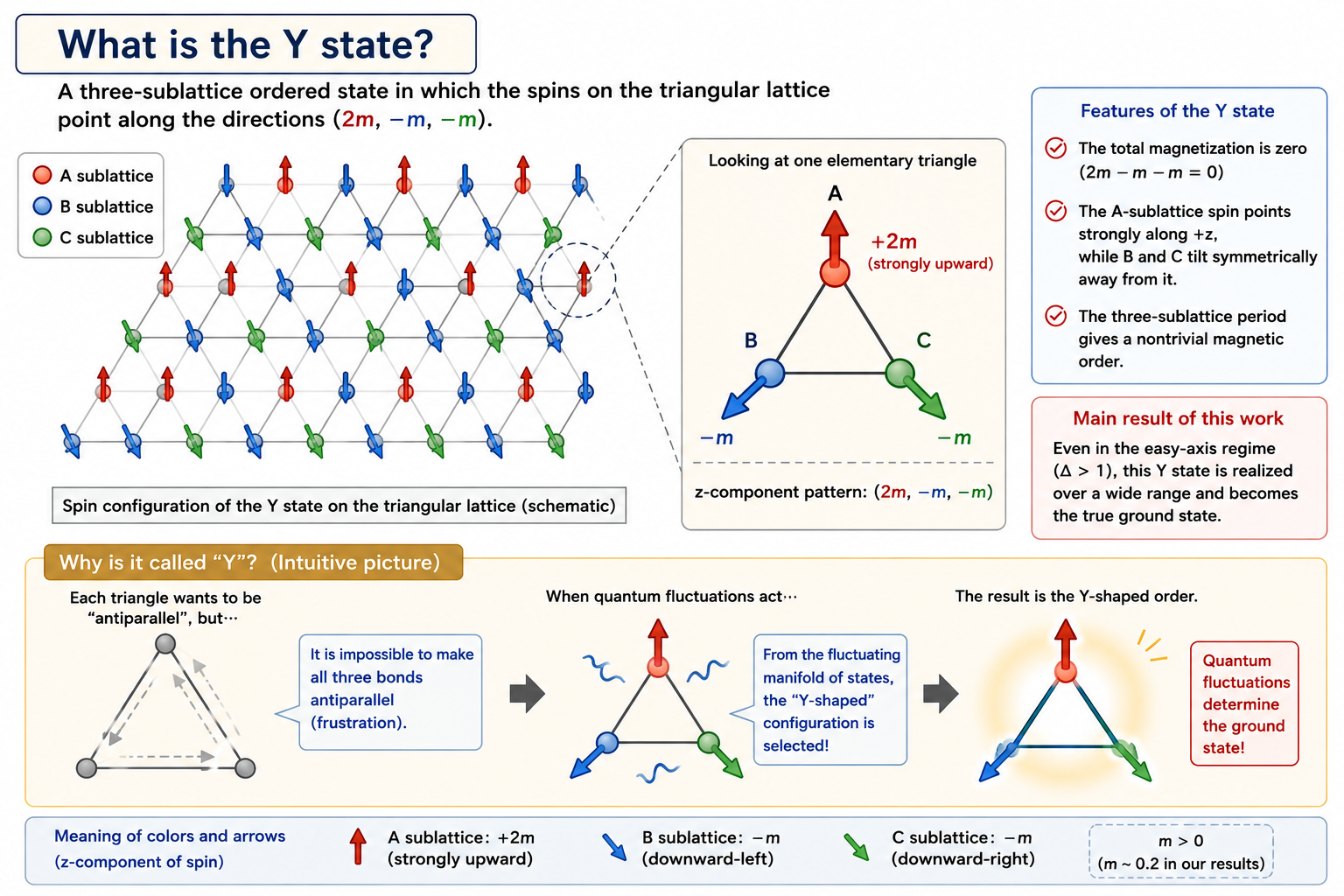
What is Y state?
Schematic illustration of the “Y state” in a triangular-lattice antiferromagnetOn a triangular lattice, neighboring spins tend to point in opposite directions, but it is impossible for all three spins on a triangle to satisfy this condition simultaneously, resulting in a competition known as “frustration.” In the Y state, the spins form three groups (sublattices): one points strongly upward, while the other two tilt downward, producing a characteristic Y-shaped magnetic order. Our study shows that this Y state remains stable even in the strongly easy-axis anisotropic regime.
credit : Masaaki Nakamura
Usage Restriction : Please get copyright permission
Contact Person
Name : Masaaki Nakamura
Phone : +81-89-927-9598
E-mail : nakamura.masaaki.dq@ehime-u.ac.jp
Affiliation : Department of Physics, Ehime University