Crystallization of ferric iron-bearing majorite from a deep magma ocean on Earth and Mars

High-pressure experiments show that majorite can store moderate amounts of ferric iron.
The valence state of iron in majorite, a major mineral in the deep interiors of Earth and Mars, was determined using high-pressure experiments and X-ray Absorption Near Edge Structure (XANES) analysis. The results show that majorite contains moderate amounts of Fe3+, suggesting that it may have played an important role in controlling the oxidation state of planetary mantles and in the formation of oxidized magmas near the surface after planetary formation.
In rocky planets such as Earth and Mars, the oxidation state of the mantle is thought to strongly influence the melting temperature of mantle materials (i.e., magma generation), the composition of volcanic gases, and ultimately the evolution of surface environments. In particular, during the solidification of the “magma ocean,” which is believed to have been widespread during the early stages of planetary formation, the oxidation state in which iron is incorporated into minerals is considered crucial for understanding subsequent mantle evolution. Iron mainly exists as either Fe2+ (ferrous iron) or Fe3+ (ferric iron), but accurately determining the Fe3+ content in minerals formed under high-pressure conditions has remained challenging.
Majorite is a major high-pressure mineral that is stable under the high-temperature and high-pressure conditions corresponding to depths of approximately 500–600 km in Earth’s mantle and to the base of the Martian mantle. Therefore, clarifying how much Fe3+ can be incorporated into majorite is important for understanding the oxidation states of planetary mantles.
The research group successfully synthesized majorite coexisting with magma at pressures of 18 GPa and temperatures of 2150–2200 °C using a multi-anvil apparatus at Geodynamics Research Center (GRC), Ehime University. Furthermore, X-ray Absorption Near Edge Structure (XANES) analyses were conducted at the synchrotron radiation facility SPring-8 to determine the Fe3+ content in the synthesized majorite. The results showed that majorite crystallized from a magma ocean contains abundant Fe3+, second only to bridgmanite, the most abundant mineral in Earth’s lower mantle. In addition, when mantle materials containing Fe3+-rich majorite ascend and undergo phase transitions or decompose into other minerals at shallower depths, excess Fe3+ that cannot be accommodated within the minerals may be released. This process may have contributed to the formation of oxidized magmas and provides important insights into the evolution of mantle oxidation states on Earth and Mars. These findings provide new constraints on the oxidation states of the interiors of Earth and Mars and are expected to contribute to a better understanding of oxidized magma formation processes on early rocky planets.
Reference URL: https://doi.org/10.1029/2025JB033231
Bibliographic Information
Title:Ferric iron content of majorite coexisting with reducing melt at 18 GPa: Implications for the mantle oxygen fugacity of Mars and Earth.
Authors:Kuwahara, H., & Nakada, R. (2026).
Journal:Journal of Geophysical Research: Solid Earth.
DOI:https://doi.org/10.1029/2025JB033231
Fundings
- Japan Society for the Promotion of Science (Grant Nos. 24K00737, 25K22048).
Media
-
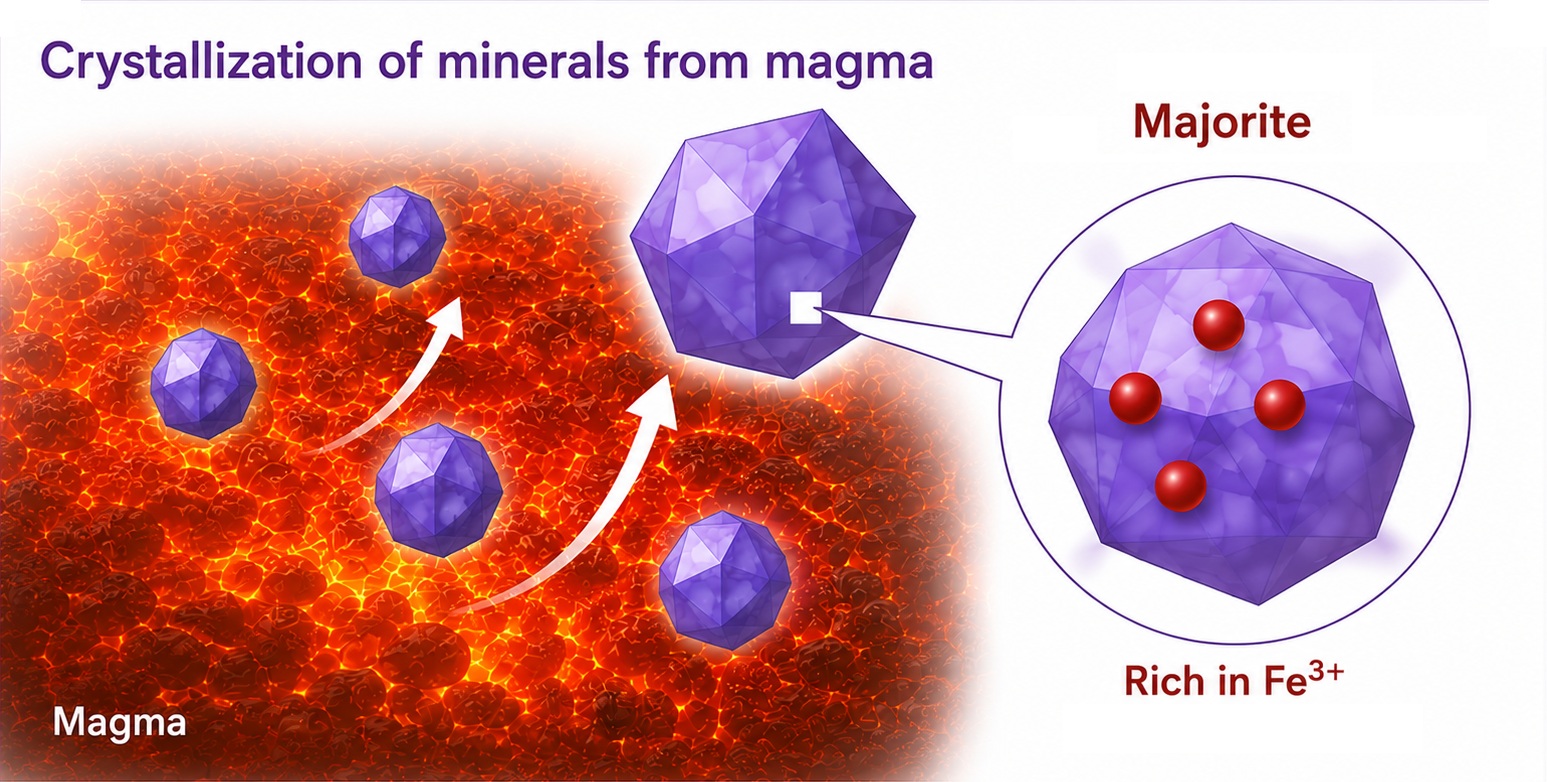
Schematic image of Fe3+-rich majorite crystallized from magma
credit : Hideharu Kuwahara
Usage Restriction : Please get copylight permission
Contact Person
Name : Hideharu Kuwahara
Phone : +81-89-927-8153
E-mail : kuwahara.hideharu.vd@ehime-u.ac.jp
Affiliation : Geodynamics Research Center, Premier Institute for Advanced Studies (PIAS), Ehime University