
Is the Moon more iron rich than what we thought ?

Elastic wave velocity measurements on a lunar orthopyroxene aggregate suggest the lunar upper mantle is more enriched in iron than previous estimates.
A research team from the Geodynamics Research Center (GRC), Ehime University, collaborating with other institutions, measured P- and S-wave velocities of a lunar orthopyroxene under high-pressure and high-temperature conditions equivalent to those in the Moon’s interior. Comparison of laboratory data with seismic models from NASA’s Apollo missions revealed the lunar upper mantle (at depths of 40–740 km) likely contains more iron than previously thought. This new finding has wide implications for the formation and evolution history of the Earth-Moon system.
The Moon is Earth’s only natural satellite, a rocky celestial body that orbits our planet at an average distance of about 384,000 kilometers. The most widely accepted scientific explanation for the Moon’s origin is the “Giant Impact”, a high-energy collision between a Mars-sized proto-planet named Theia with the young “proto-Earth” about 4.5 billion years ago. As the newly formed Moon cooled down from a hot Magma Ocean, layers with varying iron-content and mineral compositions crystallized to form the Moon’s structure that we know nowadays. The Moon has no weather nor plate tectonics and therefore its internal composition and structure has barely changed since its formation. Since the Earth and Moon share a common origin, understanding the Moon’s interior may act as a proxy for investigating the composition of the early Earth and evolution history of the Earth-Moon system.
To this day, information about the Moon’s interior has been mainly inferred from lunar seismic data recorded by seismometers deployed during NASA’s Apollo missions. However, linking seismic wave velocities to specific mineral compositions requires knowledge of the elastic wave velocities of the lunar mantle constituent minerals under high-pressure and high-temperature conditions. Unlike for the Earth’s minerals, elasticity data of lunar mantle’s minerals, which are substantially enriched in iron compared to their terrestrial counterparts, are still scarce.
The research team investigated the P‐ and S‐wave velocities and density of a lunar orthopyroxene up to 5.5 GPa and 1,273 K by using ultrasonic techniques combined with synchrotron X‐ray measurements in a multi‐anvil press at the synchrotron radiation facility SPring-8 (Japan). Based on the newly obtained elasticity data combined with literature data for iron-rich olivine, they modeled the P‐ and S‐wave velocities and density of lunar upper mantle rock. Their model indicates that lunar mantle rock containing 20 mol.% iron are required to explain seismological observations of the lunar upper mantle at the depths of 40–740 km. This new finding has wide implications for the formation and evolution history of the Earth-Moon system such as the composition of the impactor, Theia, may have been denser and richer in iron than previously thought. This would also suggest the early Moon’s volcanism and internal dynamics was more active, which would lead to faster cooling and longer-lived lunar dynamo.
Reference URL: https://agupubs.onlinelibrary.wiley.com/doi/10.1029/2025GL118120
Bibliographic Information
P- and S-wave Velocity Measurement of Lunar Orthopyroxene up to 5.5 GPa and 1,273 K: Implication for the Iron Content of the Lunar Upper Mantle, Yoshihiro Inoue, Yoshio Kono, Steeve Gréaux, Jie-Jun Jing, Sho Kakizawa, Itaru Ohira, Noriyoshi Tsujino, Yuji Higo, Geophysical Research Letters, 53, e2025GL118120, doi:10.1029/2025GL118120, 2026 (January 15)
Fundings
- Japan Society for the Promotion of Science (JSPS) under Grant‐in‐Aid for Scientific Research (Grant Numbers: 21H04622, 22K18736, 23KK0065, 23K25970)
Media
-
Probing the Moon interior by measuring elastic wave velocities of lunar constituent minerals
Schematic representation of elastic wave velocity measurement on lunar constituent minerals.
credit : Steeve Gréaux
Usage Restriction : Please get copyright permission -
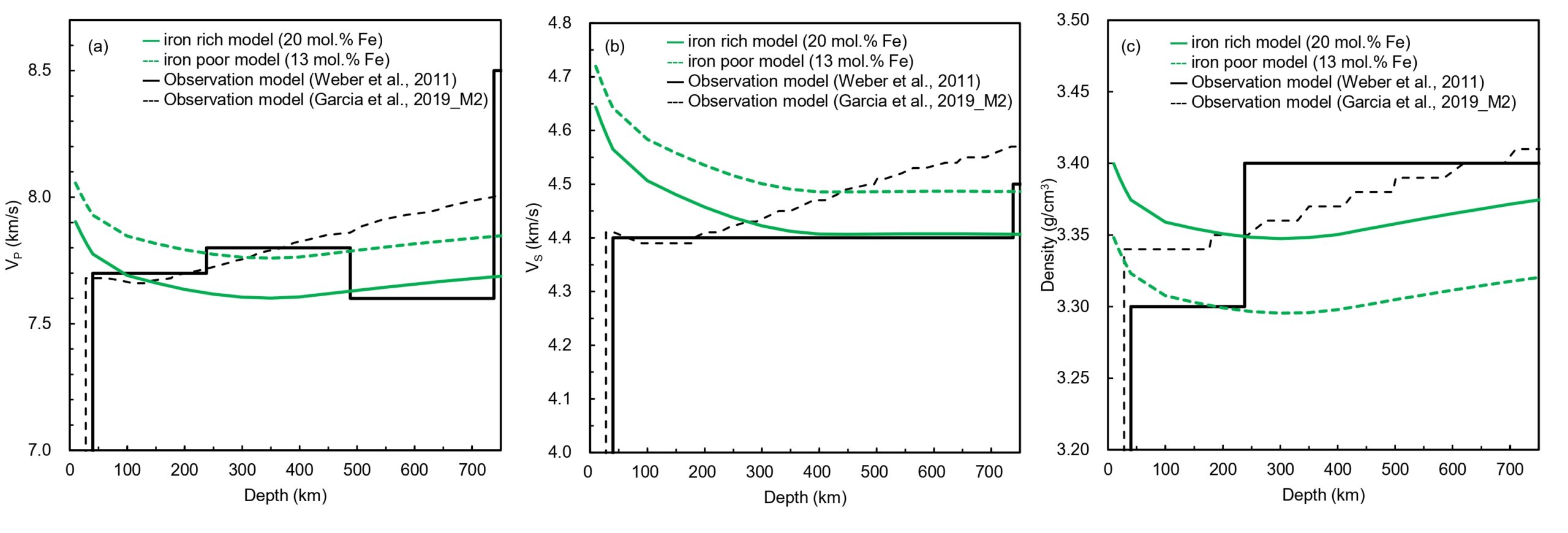
P- and S-wave velocity models of lunar upper mantle rock aggregate
(a) P- and (b) S-wave velocity (VP and VS), and (c) density models along an average selenotherm (Guo et al., G3 2024) for lunar upper mantle rocks containing 20 mol.% Fe (this study) and 13 mol.% Fe (previous estimates), respectively. Comparison with seismic data from NASA’s Apollo missions (Weber et al., Science 2011; Garcia et al., SSR 2019) suggests the Moon interior is more enriched in iron than previous estimates based on petrological studies.
credit : Yoshihiro Inoue
Usage Restriction : Please get copyright permission
Contact Person
Name : Yoshihiro Inoue, Steeve Gréaux
Phone : +81 89 927 8405
E-mail : greaux.steeve_georgi.me@ehime-u.ac.jp
Affiliation : Geodynamics Research Center, Ehime University