
Aromatase in adipose tissue exerts an osteoprotective function in male mice via phosphate regulation

The possible existence of a new phosphate regulatory mechanism through estrogens biosynthesized by aromatase in adipose tissue
We generated bone forming cell (osteoblast)- or adipocyte-specific aromatase deficiency mice. Although osteoblast-specific aromatase deficiency mice had no bone loss phenotype, male adipocyte-specific aromatase deficiency mice (AroΔaP2) exhibited bone loss and increased osteoid due to decreased serum phosphate and urinary phosphate reabsorption because of reduced phosphate transporters (NaPi2) protein expression in the kidney. These results indicate that locally synthesized estrogens by aromatase in adipocytes can play a significant role in bone mass maintenance.
Aromatase contributes to maintenance of bone mass because male patients with loss-of-function mutations of CYP19A1 exhibit bone loss. Treatment with aromatase inhibitor also causes bone loss in men and post-menopausal women, suggesting that part of the anabolic effect of testosterone in men is dependent on estradiol (E2) biosynthesized by aromatase in non-gonadal tissues. It remains unclear how locally biosynthesized E2 contributes to maintenance of bone mass. We examined the function of aromatase in local tissues rather than gonads using cell-type specific aromatase knockout (KO) mice. Because osteoblast-specific aromatase KO mice exhibited no bone phenotype, we focused on adipose tissue, known as a reservoir of steroid hormones and analyzed the bone phenotypes of adipose tissue-specific aromatase KO (AroΔaP2) mice. Sixteen-week-old male AroΔaP2 mice exhibited significantly lower bone mineral density in tibia and femur, especially in trabecular bone, than controls. Bone histomorphometry showed that AroΔaP2 mice exhibited an insufficient calcification bone phenotype with increased osteoid volume and width, and decreased osteoclast area and numbers. Moreover, serum phosphate, renal phosphate reabsorption, and FGF23 were significantly lower in AroΔaP2, suggesting that the insufficient calcification phenotype in AroΔaP2 was not caused by excessive FGF23 activities. Finally, we analyzed NaPi2a and NaPi2c, phosphate transporters localized in the kidney and found that protein levels in renal brush border membrane vesicles were lower in AroΔaP2. These results indicate that estrogens locally biosynthesized by aromatase in adipocytes can play a significant role in bone mass maintenance via regulation of phosphate reabsorption in the kidney by NaPi2.
Reference URL: https://academic.oup.com/jbmr/article/41/3/324/8257523?login=true
Bibliographic Information
Aromatase in adipose tissue exerts an osteoprotective function in male mice via phosphate regulation.
Ikedo A, Yamashita M, Hoshino M, Okuno Y, Koike M, Uga M, Tanifuji K, Segawa H, Fukumoto S, Imai Y.
Journal of Bone and Mineral Research. 2026 Mar 2;41(3):324-335.
doi: 10.1093/jbmr/zjaf129.
Fundings
- Medical Research Grant, Takeda Science Foundation to A.I.
- Japan Society for the Promotion of Science KAKENHI (JP23689066, JP15H04961, JP19H03786, JP22H03203, to Y.I.; JP19K18502, JP21K16688, to A.I.; JP22K09358 to Y.I., A.I.)
Media
-
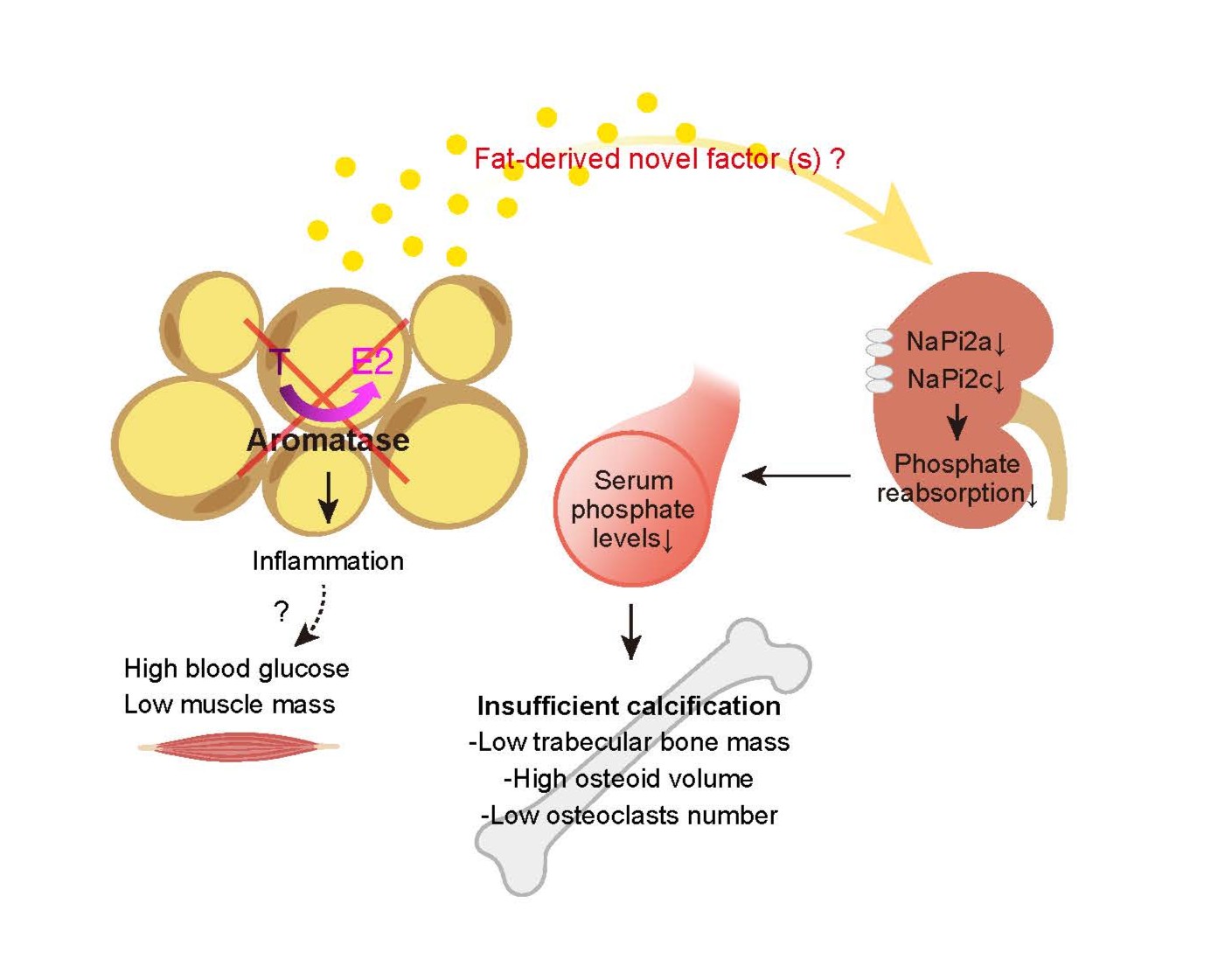
Aromatase in adipose tissue regulates bone mass via phosphate metabolism in the kidney
In AroΔaP2 mice, E2 biosynthesis by aromatase in adipose tissue was suppressed, resulting in suppression of fat-derived novel factor (s) that regulates renal NaPi2 protein levels, suppressing renal phosphate reabsorption and reducing serum phosphate levels. As a result, AroΔaP2 mice exhibited an abnormal bone calcification phenotype.
credit : Aoi Ikedo and Yuuki Imai
Usage Restriction : Permission should be obtained
Contact Person
Name : Yuuki Imai
Phone : +81-89-960-5925
E-mail : y-imai@m.ehime-u.ac.jp
Affiliation : Division of Integrative Pathophysiology, Proteo-Science Center, PIAS, Ehime University