
Gold nanoparticles × semiconductor for ethanol detection
Detecting volatile organic compounds(VOCs)with high sensitivity
By combining gold nanoparticles with a p-type semiconductor, we successfully achieved highly selective detection of ethanol, one of the volatile organic compounds(VOCs). In addition, the mechanism of high selectivity was elucidated through experimental characterization and computational analysis.
By combining gold nanoparticles with a p-type semiconductor, we successfully achieved highly selective detection of ethanol, one of the volatile organic compounds(VOCs). In addition, the mechanism of high selectivity was elucidated through both experimental characterization and computational simulations.
Since the revision of Japan’s Road Traffic Act in 2022, semiconductor-type alcohol sensors—compact and low-cost devices capable of detecting alcohol in breath—have gained significant attention. However, their low gas selectivity remains a major issue. In this study, we investigated the synergistic effects of incorporating Au(gold)nanoparticles into SmFeO3-based p-type semiconductors for detecting ethanol and toluene, as part of the development of advanced alcohol sensors. The results revealed that Au nanoparticles significantly improve selectivity and sensitivity toward ethanol through strong adsorption and catalytic oxidation at the SmFeO3 interface.
X-ray photoelectron spectroscopy(XPS)analysis showed that increasing Au content enhances both lattice and adsorbed oxygen species on the SmFeO3 surface. Furthermore, density functional theory(DFT)calculations demonstrated that ethanol binds strongly to the Au–SmFeO3 interface, and that oxygen migration on the Au surface facilitates ethanol oxidation. These findings indicate that Au–SmFeO3 composite materials hold great promise as highly selective sensing materials for ethanol detection among VOCs.
Reference URL: https://www.sciencedirect.com/science/article/pii/S0925400525009189?via%3Dihub
Bibliographic Information
Title:Synergistic effects of Au nanoparticles in SmFeO3-based p-type semiconductors for ethanol and toluene detection
Author:Tatsuya Joutsuka, Shinsuke Ishiguro, Kosei Kuryu, Masami Mori, Hiromichi Aono, Hiroyuki Yamaura, and Yoshiteru Itagaki
Journal:Sensors and Actuators B: Chemical, 442, 138142
DOI:10.1016/j.snb.2025.138142, 2025(June 16).
Fundings
- Ehime University Research Unit(Research Unit of Regional e-Fuel)
Media
-
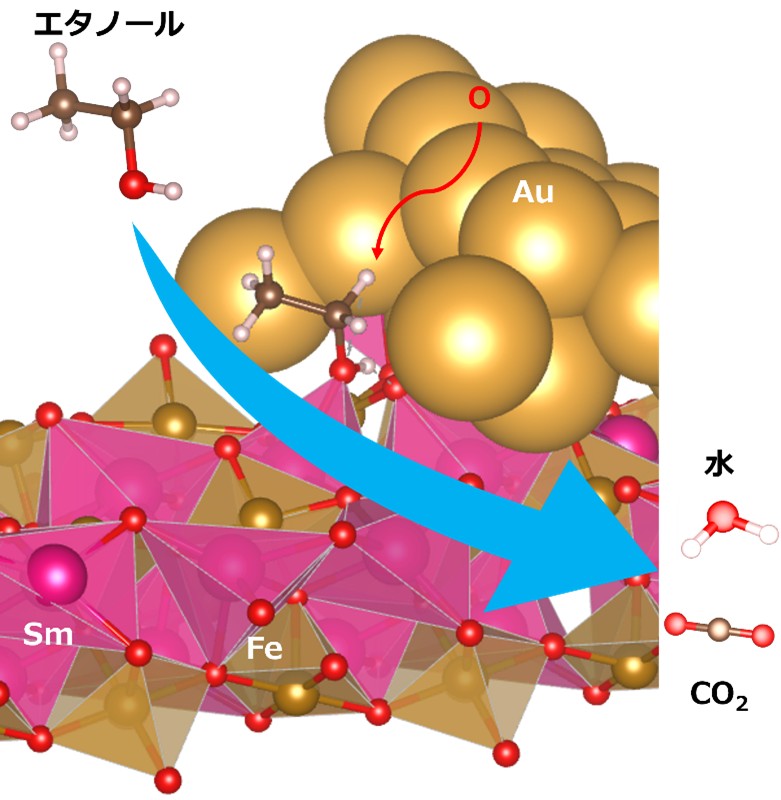
Ethanol detection using an Au–SmFeO3 composite sensor
Ethanol molecules are strongly adsorbed at the Au–SmFeO3 interface, where they are oxidized by dissociatively adsorbed oxygen on the Au surface, and finally converted into water and CO2.
credit : Tatsuya Joutsuka(Ehime University)
Usage Restriction : Please get copyright permission -
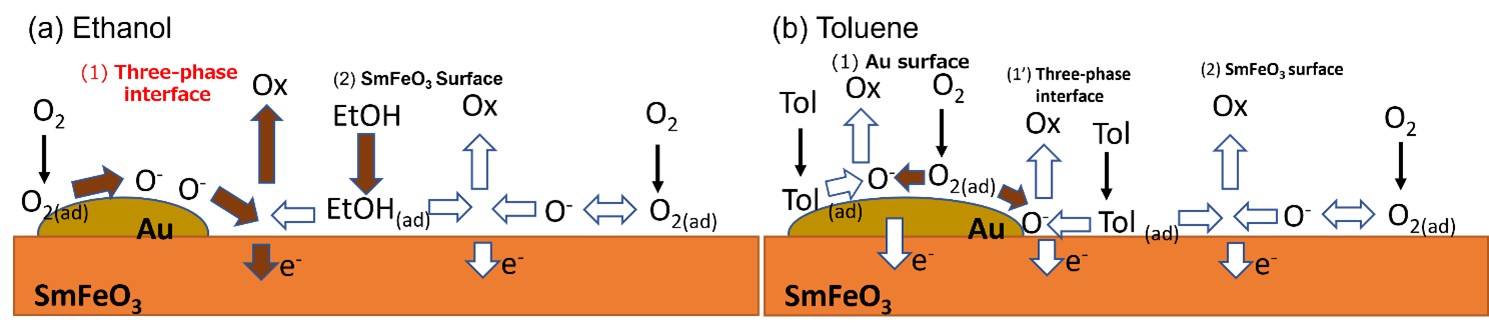
Mechanism of (a) ethanol (EtOH) and (b) toluene (Tol) detection via oxygen spillover effect in the Au–SmFeO3 composite sensor
Oxygen on the SmFeO3 surface promotes the ethanol reaction through Au-mediated spillover, and the Au–SmFeO3 interface serves as a strong binding site, leading to preferential detection of ethanol.
credit : Yoshiteru ITAGAKI(Ehime University)
Usage Restriction : Please get copyright permission
Contact Person
Name : Yoshiteru ITAGAKI
Phone : 089-927-9755
E-mail : itagaki.yshiteru.mj@ehime-u.ac.jp
Affiliation : Graduate School of Science and Engineering, Ehime University